
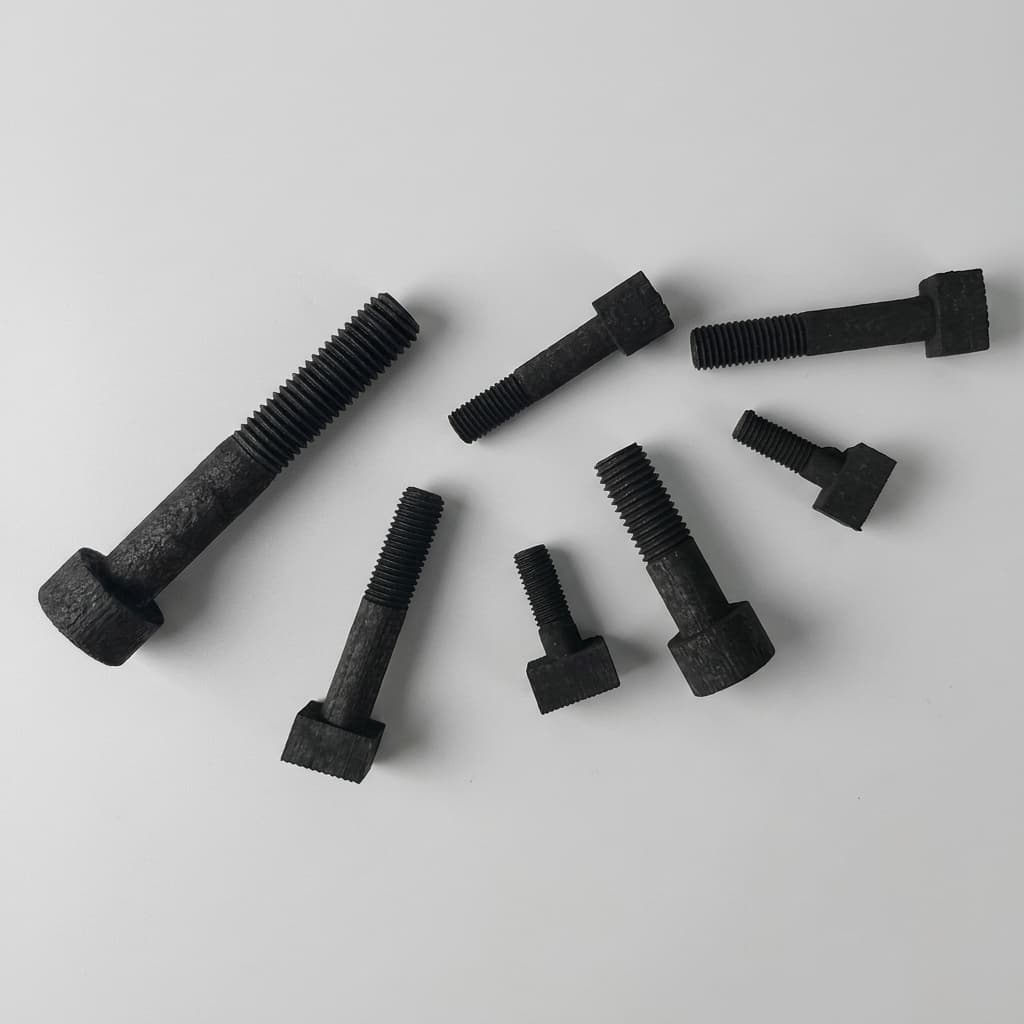
C/C Composite Fasteners vs. Molybdenum in Vacuum High-Temperature Furnaces
A technical comparison of Carbon/Carbon composites and Molybdenum hardware in vacuum furnaces. Discover why C/C composites are replacing refractory metals.
When designing or upgrading a vacuum high-temperature furnace (operating ), equipment engineers face a critical decision for load-bearing structures and fasteners: should they use traditional refractory metals like Molybdenum (Mo) or adopt Carbon/Carbon (C/C) composites?
Executive Summary (Key Takeaways)
- Thermal Fatigue: Molybdenum can suffer recrystallization embrittlement above , increasing fastener failure risk during maintenance. C/C composites avoid this metal embrittlement mechanism.
- Weight-to-Strength: C/C composite can be much lighter than Molybdenum while retaining useful high-temperature strength, reducing thermal mass in suitable designs.
- Outgassing: High-purity C/C can support low-outgassing vacuum furnace designs when material grade, processing, and cleaning are controlled.
Historically, Molybdenum was the default choice for high-temperature strength. However, as furnace volumes increase and process temperatures push past , the disadvantages of refractory metals become glaring.
C/C composites are rapidly becoming the industry standard for thermal-field hardware. Here is the engineering rationale.
1. Weight-to-Strength Ratio
The most immediate difference between these materials is density. Molybdenum is an extremely dense metal (), while C/C composite is remarkably lightweight ().
Despite being nearly 6 times lighter, advanced 2D and 3D C/C composites exhibit comparable or superior tensile strength, especially as temperatures rise.
Figure: Tensile strength behavior at elevated temperatures. Molybdenum loses strength rapidly above 1200°C, while C/C composite actually gains strength up to 2000°C.
Why it matters for furnace design:
Lighter C/C trays and fixtures mean less thermal mass. The furnace can heat up and cool down significantly faster, increasing throughput and saving massive amounts of electrical energy. Furthermore, operators can handle C/C fixtures manually without heavy lifting equipment.
2. Embrittlement and Lifespan
One of the most frustrating aspects of Molybdenum hardware is recrystallization embrittlement.
When Molybdenum is exposed to temperatures above and subsequently cooled down to room temperature, the grain structure alters. It becomes extremely brittle. A Molybdenum bolt that survived a run will often snap like glass when a technician tries to unscrew it during maintenance.
C/C Composites do not suffer from embrittlement. Because they consist of continuous carbon fibers suspended in a carbon matrix, they maintain their structural integrity and toughness regardless of how many thermal cycles they endure. A C/C threaded nut can be unscrewed and reused hundreds of times.
3. Thermal Shock Resistance
Vacuum furnaces occasionally experience sudden loss of power or emergency cooling events.
- Molybdenum has a high coefficient of thermal expansion (CTE) and lower thermal shock resistance. Sudden temperature drops can cause Moly fixtures to warp, permanently deforming the hot zone structure.
- C/C Composites have very low CTE and strong thermal shock resistance compared with many refractory metals. Actual performance still depends on fiber architecture, part geometry, atmosphere, and handling conditions.
4. Outgassing Rates in Deep Vacuum
For processes operating under deep vacuum (e.g., mbar or lower), the outgassing behavior of structural materials dictates pump-down time and ultimate vacuum levels.
Molybdenum requires extreme care in surface preparation (electropolishing) to minimize trapped oxygen and water vapor. If oxidized, Molybdenum outgasses heavily as temperature increases, potentially poisoning sensitive semiconductor batches.
High-Purity C/C Composites undergo specialized halogen purification at during manufacturing. This process completely drives off volatile impurities. As a result, the outgassing rate of purified C/C composites in high vacuum is virtually undetectable, enabling significantly faster pump-down cycles compared to large Molybdenum heat sinks.
5. Total Cost of Ownership (TCO)
Molybdenum fasteners are typically cheaper to purchase upfront than highly engineered 3D C/C composite fasteners. However, the TCO heavily favors carbon.
| Factor | Molybdenum Hardware | C/C Composite Hardware |
|---|---|---|
| Upfront Cost | Lower | Higher |
| Reusability | Low (snaps after thermal cycling) | Extremely High (reusable for years) |
| Energy Consumption | High (massive heat sink) | Low (low thermal mass) |
| Maintenance Labor | High (frequent drill-outs required) | Low (easy assembly/disassembly) |
| Max Temperature | (starts to creep) |
For vacuum furnaces or semiconductor thermal zones operating above , C/C composites are worth evaluating when weight, thermal cycling, and fixture maintenance are major constraints. ROI depends on part geometry, service cycle, atmosphere, and replacement cost.
Ready to upgrade your hot zone?
SiC Graphite supports custom 2D and 3D C/C composite plates, trays, bolts, and nuts. Contact our engineering team with your Molybdenum drawings, and we can review whether a C/C replacement proposal is feasible.
More Posts
Preventing Wafer Slip and Bow in 200mm SiC Epitaxy: Susceptor Specifications
A comprehensive engineering and procurement guide to mitigating wafer slip, bow, and warp in 200mm SiC epitaxy through advanced SiC coated graphite susceptor design.

How to Choose High-Purity Isostatic Graphite for Semiconductor Crystal Growth
A buyer's guide to isostatic graphite for SiC PVT and silicon CZ growth. Learn how grain size, bulk density, and ash content affect yield.
Evaluating SiC Coated Graphite Quality: How to Prevent Coating Delamination
A comprehensive engineering and procurement guide to identifying, preventing, and sourcing CVD SiC-coated graphite susceptors immune to delamination and pinholes.