
Engineering guide · Evidence reviewed
C/C Composite Bolts Purity Requirements
Set ash and elemental targets, check process risks, and export a draft RFQ.
Start the purity RFQ builder ↓Build a bolt purity RFQ
Choose an illustrative profile, edit targets, and export a draft with open reviews. Results update immediately on this device.
Required targets use ppm by mass (1 ppm = 1 mg/kg). These are requested limits, not measured certificate values.
Send the hold reasons with the draft to your supplier. Obtain written process and joint qualification before release.
HOLD: Above 2000°C, the cited example fastener-grade datasheet does not establish suitability. Request a grade-specific temperature and load envelope.
Ash target
≤ 2 ppm wt
Selected-element target subtotal
0.25 ppm wt
No certification or service approval is produced. The subtotal covers Fe, B, P, Ni+Cr and Na+K only; ash is separate.
Review assumptions, holds & target comparison
- All values are proposed upper limits, not measurements. Example comparisons are editorial RFQ starting points, not standard limits or certification.
- Ash and the selected-element subtotal are different measurements. Neither establishes total purity, outgassing, or safe bolt loading.
- HOLD: Above 2000°C, the cited example fastener-grade datasheet does not establish suitability. Request a grade-specific temperature and load envelope.
- ASTM C561 is not intended for purified graphite. Agree a validated low-level ash method separately from elemental analysis; no universal 5–10 ppm detection floor is assumed.
- For elemental analysis, agree a matrix-validated GDMS or other suitable method and per-element LOQs. ASTM D8186-25 describes ETV-ICP-OES and allows C/C application with validation; it is not a GDMS standard.
| Element | Your target | Example ceiling | Comparison |
|---|---|---|---|
| Fe | 0.1 | 0.2 | within example |
| B | 0.03 | 0.05 | within example |
| P | 0.02 | 0.05 | within example |
| Ni + Cr | 0.05 | 0.1 | within example |
| Na + K | 0.05 | 0.1 | within example |
Method: compare proposed limits with the editorial example; flag atmosphere, temperature and final-machining evidence gaps. Read the method and evidence boundaries.
Four decisions before choosing a purity grade
Separate residue from elemental limits
An ash number cannot replace a per-element report. Specify both method and measurand.
[1][2]Treat supplier values as grade-specific
Published typical properties are a comparison starting point. Get an agreed specification for the actual finished bolt.
[4]Match test capability to the target
A sensitive instrument alone is insufficient. Ask for matrix validation and per-element reporting limits.
[3][2]Qualify atmosphere separately
Purity cannot establish oxidation resistance or joint life. Request application testing rather than interpreting a low ash value as permission to run.
[6]What the builder checks — and what remains unknown
This is a deterministic specification aid, not a certificate checker. Presets are editorial examples retained for RFQ comparison. No public source cited here establishes universal SiC PVT, CZ or MOCVD bolt impurity ceilings. Replace example values with a process-owner-approved budget before contracting.
| Check | Visible behavior | Evidence still needed |
|---|---|---|
| Numeric input | Required positive values within displayed UI bounds; invalid input blocks export | Actual application limits; input bounds imply no safety envelope |
| Element targets | Any exceedance of an example ceiling flags review; no 50% tolerance allowance | Buyer-approved limits and individual elemental results |
| Selected subtotal | Fe + B + P + (Ni+Cr) + (Na+K), ppm wt | Complete agreed impurity panel; subtotal is not a total assay |
| Air / oxygen | Hold at ≥350°C for all treatments; review required below it too | Grade, oxygen exposure, coating integrity and loaded cycling |
| Reactive gas | Hydrogen/ammonia or halogen selections place the draft on hold | Species, partial pressures, exposure and reactor-specific evidence |
| Temperature | Above 2000°C: hold for a grade-specific envelope | This review trigger follows the cited example grade, not all C/C |
| Final machining | Sensitive applications need final-part cleanliness evidence | Validated purification/cleaning sequence and representative sampling |
The air review trigger is a conservative editorial rule, not a universal oxidation onset. Temperature, exposure time, grade, pressure and load are not modeled. No output certifies compliance, calculates allowable torque, predicts wafer yield or prescribes a chemical purification cycle.
[4][6]Define ash and elemental purity on separate lines
For mass fractions, 1 ppm wt = 1 mg/kg = 1 µg/g; 1% = 10,000 ppm. Record whether a number is a proposed maximum, a measured value, or a reporting limit. Those meanings cannot be interchanged. A missing result is unknown, and a nondetect is not zero.
| RFQ line | Define explicitly | Do not infer |
|---|---|---|
| Ash | Maximum residue, validated method, sample mass and reporting limit | Total metal concentration or total carbon purity |
| Individual elements | Element, ppm wt maximum, method and acceptance rule | A universal semiconductor grade from the application name |
| Combined budgets | Which elements are included and how nondetects are counted | Individual compliance from a combined value alone |
| Total impurity | Complete analyte list, excluded elements and sum convention | A total assay from this tool’s five-field subtotal |
| Surface cleanliness | Final-thread sample, extract or agreed surface test | Clean finished threads from a purified billet report |
| Uncertainty | Reporting uncertainty and the agreed decision rule near a limit | Guaranteed acceptance from a rounded value |
Choose a method that can answer the purchase question
| Method | Useful output | Ask the laboratory |
|---|---|---|
| ASTM C561-23 ash | Approximate nonburnable residue comparison | Its scope excludes purified graphite; what validated method covers this target and C/C matrix? |
| GDMS | Solid-sample multi-element analysis | Matrix calibration, sample geometry, surface preparation, interferences and per-element LOQs? |
| ETV-ICP-OES / ASTM D8186-25 | Elemental mass fractions by electrothermal vaporization | Has the method been validated for this fiber-reinforced carbon material and the specified elements? |
| Digestion + ICP-MS / ICP-OES | Element concentrations after sample preparation | Complete recovery, blanks, matrix effects and volatile losses demonstrated? |
| Surface extract / particle inspection | Contamination relevant to handling or final machining | Which surface area, extraction procedure and acceptance limits? Not a bulk assay. |
| Outgassing / process bake trial | Gas release under defined conditions | Sample area, pressure, temperature, dwell and blank correction? Not established by ash. |
No universal ash detection floor is asserted. For elemental tests, require an LOQ that supports the agreed limit for each element. For example, a result “B <0.1 ppm” cannot establish “B ≤0.03 ppm.” Request a more sensitive validated method rather than treating the nondetect as a pass.
Build an application-specific element panel
Use a contamination budget from the process owner. The groups below are procurement prompts, not a causal model of crystal defects or a standard limit table. The actual transport route and process impact need confirmation. The elemental method must cover the final agreed panel. [2][3]
| Group | Question for the process owner | Supplier evidence |
|---|---|---|
| Fe, Ni, Cr, Cu | Which metals are restricted by the device or workpiece specification? | Separate values, suitable LOQs and lot identity |
| B, P, Al | Which electrically active impurities need a background budget? | Individual targets agreed for the particular process |
| Na, K, Ca | Are mobile ions or handling residues controlled? | Bulk and surface methods matched to the contamination concern |
| W, Co, Ti | Could tooling or fixtures contribute these elements? | Final-part samples and a validated machining/cleaning route |
| S, Cl, F | Are residual treatment species relevant to the process? | An agreed analyte/method plan; no assumption that a generic scan covers everything |
| Other species / particles | Does the process require separate gas, moisture or particle controls? | Separate sampling and acceptance criteria |
Qualify the finished thread, not just the starting billet
Supplier literature confirms gas purification is available for C/C. It does not establish a single gas mixture, temperature, duration or guaranteed removal efficiency for every fastener. Request the supplier’s validated route and finished-lot evidence. [5]
As a procurement control, identify every operation after the certified material stage: machining, cleaning, coating, inspection and packing. A billet result does not by itself describe a subsequently machined thread surface. If final-part testing is destructive, agree representative witness samples and document why they represent the production lot.
Separate purity, coatings and mechanical suitability
The SGL Mechanical datasheet gives typical ash values of 1000 ppm and <10 ppm for its purified variant, with 2000°C listed for vacuum/inert service. It expressly directs designers to supplier review. These are properties of that grade, not promises for our products or proof of suitability in a 2250°C PVT joint. [4]
| Decision | Evidence to request | Limit / alternative |
|---|---|---|
| Purity | Validated final-lot residue and elemental results | Coatings do not establish core purity |
| Oxidation | Grade-specific air-exposure and loaded-cycle evidence | Coating selection cannot clear a hold; consider a qualified material/system change |
| Reactive gas | Gas chemistry, partial pressure and coating/substrate tests | Use reactor-supplier-approved hardware if compatibility is unknown |
| Surface barrier | Coating thickness, adhesion, defects and thread dimensions | A barrier changes geometry and still needs process testing |
| Thread capacity | Architecture, engagement, mating material and torque/load qualification | No generic metric-size torque table or universal lubricant is provided |
| Vacuum behavior | Bake procedure and measured outgassing under agreed conditions | Low ash alone is not an outgassing specification |
Balance contamination risk, cost and process fit
| Choice or risk | Benefit / cost exposure | Practical mitigation |
|---|---|---|
| Tighter impurity targets | May increase treatment, sampling and analytical effort; no price uplift is assumed | Use the process budget; request cost and lead-time options for agreed tiers |
| Small destructive-test lots | Testing may consume a significant share of the parts | Agree witness samples and lot representativeness before manufacture |
| Low LOQ demands | A method may need additional validation or another laboratory | Confirm capability before placing the order |
| Coating by default | Adds inspection and dimensional qualification work | Specify a coating only for an identified process need |
| Wrong material/atmosphere | Purity improvements cannot resolve an incompatible joint | Review qualified ceramics, metals or a redesigned fixture with the furnace supplier |
| Uncontrolled handling | A clean lot can be recontaminated after acceptance | Agree handling, packaging, storage and opened-package controls |
These are engineering planning tradeoffs, not measured cost, lifetime or yield predictions. If evidence is missing, keep the release on hold and ask for a limited qualification lot rather than assuming a production benefit.
Three worked RFQ scenarios
Illustrative decision exercises; these are not customer case studies or measured production outcomes.
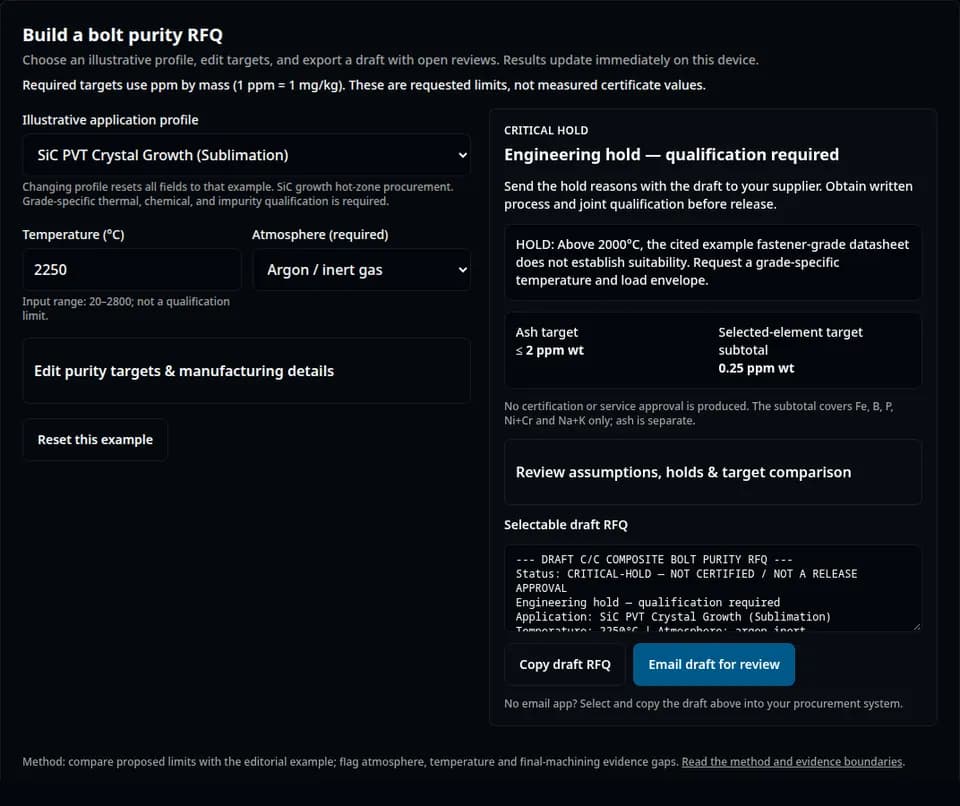
SiC PVT at 2250°C in argon
Premise: the example limits fit the editorial profile. Process: enter temperature and inspect open reviews. Result: engineering hold above 2000°C; request a supplier-specific thermal/load envelope and agreed elemental limits. No crystal-yield improvement is predicted.
Low-ppm lot report with an inadequate LOQ
Premise: the buyer requests B ≤0.03 ppm; the report says B <0.1 ppm. Process: compare the reporting capability with the target. Result: inconclusive, not a pass. Request retesting with a suitable matrix-validated method. The builder itself does not ingest a certificate.
Coated furnace bolts at 650°C in air
Premise: a CVD SiC coating is selected. Process: choose air exposure. Result: hold remains regardless of the coating. Obtain complete-joint oxidation/cycle evidence or review an approved alternative; no service-life claim is made.
Procurement, packaging and release checklist
- Attach a drawing: thread, tolerance, engagement, architecture, mating part and quantity.
- State atmosphere species and pressure, temperature, dwell, cycles and load; qualify torque separately.
- Replace example targets with buyer-approved ash and individual element limits, units and methods.
- Agree final-part or representative sampling, lot definition and traceability through purification, machining and coating.
- Obtain LOQs, uncertainty, nondetect handling and a documented acceptance rule; review values near limits.
- Agree handling, bag material, moisture/particle requirements and labels. A cleanroom classification describes air, not bolt chemical purity. [7]
- Resolve all atmosphere, mechanical and analytical holds in writing before releasing the production lot.
Frequently asked procurement questions
Limits and measurement
What purity is required for C/C composite bolts?
Agree requirements with the process owner: an ash target and method, individual elemental limits, a sampling plan, and a lot acceptance rule. The cited sources do not establish one universal semiconductor bolt specification.
Does 2 ppm ash mean 2 ppm total elemental impurity?
No. Ash is residue from a specified test. Elemental analysis measures a defined panel using another method. Do not convert one directly into the other or subtract ash from 100% to certify carbon purity.
Can ASTM C561 certify purified C/C at a low-ppm target?
Its public scope explicitly excludes purified graphite. Ask the lab to validate the actual matrix and the requested low-level residue method; request an elemental report separately.
Is GDMS the only acceptable method?
No. Select a method with demonstrated fitness for your matrix and limits. GDMS is a candidate; ASTM D8186-25 describes ETV-ICP-OES with validation for C/C. Digest-based methods require validated preparation and recovery.
What does a nondetect mean?
A result reported below a detection or quantification limit is not zero. If the reporting limit is higher than the agreed acceptance limit, that result cannot demonstrate compliance. Ask for a suitably sensitive method.
Why does the builder combine Ni+Cr and Na+K?
These are compact RFQ budget fields. A combined budget does not replace individual elemental results. Ask the lab for separate Ni, Cr, Na and K values, and agree how nondetects contribute to the sum.
Manufacturing and release
Can a coating replace substrate purity qualification?
No. Qualify the substrate, coating, final dimensions and complete joint for the application. A coating choice in this tool is only a requested treatment and supplies no evidence of protection.
Must purification happen after machining?
Final machining can introduce new surface contamination. Request a validated final-part cleanliness route. Post-machining purification is one route; an alternative needs representative test evidence rather than a billet certificate alone.
Does the tool approve SiC-coated bolts in hot air?
No. Air operation at or above the conservative 350°C review trigger remains on hold for every treatment. Below that trigger, service approval is still absent. Coating integrity, time, cycling and load require qualification.
What tightening torque should I use?
Use the bolt supplier’s qualified value for the exact fiber architecture, thread engagement, mating part and surface condition. This page gives no universal torque table or lubricant recommendation.
Does ISO Class 5 guarantee chemically clean packaging?
No. ISO 14644-1 concerns airborne particles. Separately agree handling, bag compatibility, extractables, moisture, particle limits and lot labeling with the supplier.
Can I issue a purchase order from the exported draft?
Use it for technical discussion first. Resolve holds, agree the complete impurity panel and test capability, attach the drawing, then obtain signed lot and joint qualification before release.
Primary references and evidence limits
Published by SiC Graphite. Published 1 November 2026; next evidence review by 1 May 2027, or sooner if a cited method or supplier document changes.
Public publisher scopes, manufacturer documents and their applicability were checked on . Full licensed standards and a laboratory validation package are still needed where applicable. A test method is not an application acceptance specification. Example limits, review triggers, scenarios and checklists above are explicitly editorial engineering guidance.
[1] ASTM C561-23 — ash testing
Public scope distinguishes an approximate residue test from purified-graphite analysis. No universal low-ppm quantification floor is established here.
Open primary reference ↗[2] ASTM D8186-25 — ETV-ICP-OES
Elemental method for graphite; extending it to C/C needs validation. This is a method reference, not a bolt acceptance specification.
Open primary reference ↗[3] Thermo Fisher — Element GD Plus GD-MS brochure
Manufacturer description of direct solid analysis and graphite applications. Instrument capability does not establish a laboratory’s C/C LOQs or a customer limit.
Open primary reference ↗[4] SGL Carbon — SIGRABOND Mechanical datasheet (September 2018)
A specific C/C grade with typical properties, not guaranteed design values or a specification for our bolts. Supplier review is needed for other grades and operating conditions.
Open primary reference ↗[5] SGL Carbon — semiconductor materials brochure
Documents gas purification of C/C components for semiconductor applications. It does not establish a universal treatment recipe or final impurity limit.
Open primary reference ↗[6] ASTM C1179-26 — oxidation mass-loss testing
Comparative carbon/graphite oxidation testing in air; not an ash test or automatic approval for a coated threaded joint.
Open primary reference ↗[7] ISO 14644-1:2015 — airborne particle classification
Classifies cleanroom air by particle concentration. It does not specify the chemical cleanliness of a bolt or mandate a packaging material.
Open primary reference ↗Get the draft reviewed for your furnace
Use the builder’s email action to include your current targets and all open reviews. For an initial discussion, send your drawing and process envelope through the contact options below.
Inquiry Email
Include process, product type, drawing status, purity/coating target, dimensions, quantity forecast, operating conditions, and delivery date.
Instant Chat
WhatsApp Engineering Support
Best for quick drawing checks, process fit questions, and RFQ clarification.