
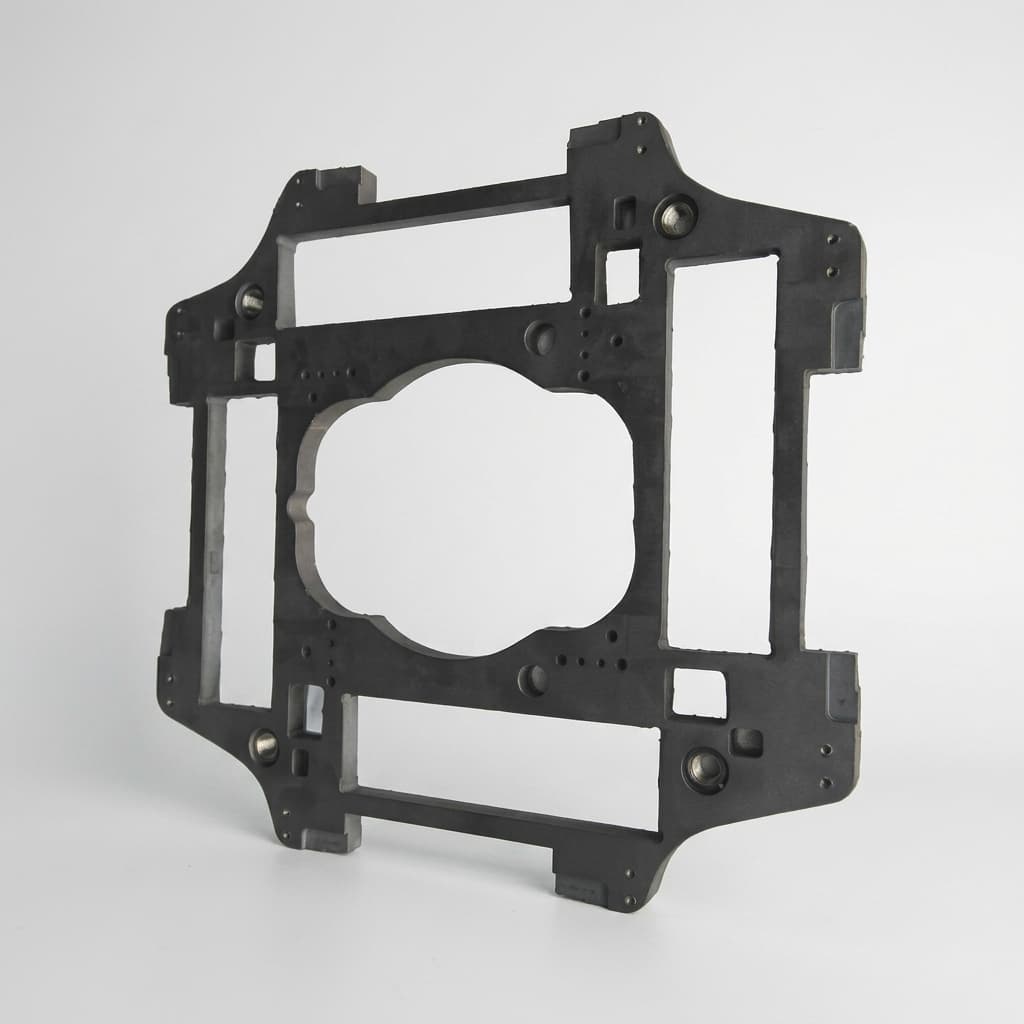
How to Choose High-Purity Isostatic Graphite for Semiconductor Crystal Growth
A buyer's guide to isostatic graphite for SiC PVT and silicon CZ growth. Learn how grain size, bulk density, and ash content affect yield.
When engineering a hot zone for SiC Physical Vapor Transport (PVT) or Silicon Czochralski (CZ) crystal growth, the quality of the graphite consumable dictates the purity and defect rate of the grown crystal. Not all "high-purity" graphite is created equal.
Executive Summary (Key Takeaways)
- Bulk Density: Must exceed for semiconductor applications. Lower densities (high porosity) allow Si/C vapors to penetrate and crack crucibles.
- Ash Content (Purity): Trace metal contamination must be strictly ppm. Demand ICP-MS halogen purification reports from your supplier.
- Grain Size: Ultrafine grain ( µm) is often required for tight CNC tolerances ( mm) and is commonly specified as a base for demanding CVD coating programs.
For procurement engineers and buyers, navigating supplier spec sheets is overwhelming. We break down the three most critical material properties—grain size, bulk density, and ash content—and explain how to match them to your process requirements.
1. Grain Size: The Microstructure Foundation
Isostatic graphite is formed by pressing carbon powder equally in all directions (isostatic pressing), resulting in an isotropic material with uniform properties. The size of the carbon grains before pressing dictates the final material's smoothness, strength, and machinability.
| Grain Size | Typical Application | Why It Matters |
|---|---|---|
| Medium ( µm) | Heaters, large thermal shields | Cost-effective for structural parts not in direct contact with reactive gases. |
| Fine (5-15 µm) | Standard crucibles, susceptors | Good balance of strength and machinability. Standard for most semiconductor needs. |
| Ultrafine ( µm) | SiC CVD substrates, precision jigs | Supports smoother machined surfaces and better CVD SiC coating adhesion when coating geometry and cleaning are controlled. |
Machining Tolerance
If your drawing calls for ultra-tight tolerances (e.g., mm) or sharp threaded profiles, you must specify ultrafine grain graphite to prevent edge chipping during CNC machining.
2. Bulk Density & Open Porosity
Bulk density () is an indicator of how tightly packed the graphite matrix is. A higher density means lower open porosity.
Why Density Matters in Crystal Growth
In SiC PVT growth (operating at ), Si and C sublimated vapors travel through the furnace. If your graphite crucible has high porosity (low density), these vapors penetrate the crucible walls, reacting to form internal SiC deposits. Over multiple runs, this causes the crucible to swell, crack, and ultimately fail.
Rule of Thumb:
- Standard Industrial: (Avoid for epitaxy/PVT)
- Semiconductor Standard: (Required for most hot zones)
- Premium/Coating Substrate: (Best for lifespan and coating adherence)
3. Ash Content: The Invisible Yield Killer
"Ash" refers to the inorganic metallic impurities remaining in the graphite after manufacturing. These include Iron (Fe), Aluminum (Al), Calcium (Ca), and Vanadium (V).
In high-temperature vacuum environments, these metals volatilize and incorporate into the growing crystal lattice, causing point defects and destroying the electrical properties of the semiconductor wafer.
Purification Levels (Ash Content)
For SiC PVT and epitaxy, ppm ash content is non-negotiable. Ensure your supplier utilizes halogen gas purification and ash control at to strip these trace metals, and demand an ICP-MS (Inductively Coupled Plasma Mass Spectrometry) report with your batch.
4. CNC Machining Constraints: The 0.01mm Tolerance Challenge
Raw material selection does not guarantee a functional part. Isostatic graphite is abrasive and brittle, making precision CNC machining notoriously difficult.
If your design requires tight dimensional tolerances (e.g., mm for wafer pocket depths) or sharp internal threads, the graphite will succumb to edge chipping if not handled correctly.
Best Practices for OEM Machining
- Diamond-Coated Tooling: Standard carbide tools can wear quickly when cutting high-density graphite, leading to dimension drift across a batch. Confirm whether your OEM uses CVD diamond-coated end mills or another qualified tooling strategy.
- Dust Control Extraction: Graphite dust acts as an abrasive paste inside CNC machines. Precision requires high-velocity vacuum extraction directly at the spindle to prevent the dust from interfering with the cutting path.
- CMM Verification: For critical tolerances, optical scanning is insufficient. Insist on CMM (Coordinate Measuring Machine) reports for the first article inspection (FAI).
5. OEM Sourcing Strategy
When sending an RFQ for graphite consumables, do not just send a CAD drawing. A complete RFQ should specify:
- Material Grade Requirements: (e.g., Isostatic, , µm grain).
- Purification Threshold: (e.g., ppm ash, with ICP-MS certificate).
- Machining Tolerances: (e.g., specify which surfaces require mm and demand CMM verification).
- Application Context: (e.g., "Used as a seed holder in SiC PVT at ").
By providing the application context, a capable OEM like SiC Graphite can recommend the exact material block from our inventory that balances your budget with your yield requirements.
Author

Categories
More Posts
Preventing Wafer Slip and Bow in 200mm SiC Epitaxy: Susceptor Specifications
A comprehensive engineering and procurement guide to mitigating wafer slip, bow, and warp in 200mm SiC epitaxy through advanced SiC coated graphite susceptor design.
Evaluating SiC Coated Graphite Quality: How to Prevent Coating Delamination
A comprehensive engineering and procurement guide to identifying, preventing, and sourcing CVD SiC-coated graphite susceptors immune to delamination and pinholes.
SiC Coated Graphite vs. Solid SiC Components: A Procurement & Engineering Guide
Compare SiC coated graphite vs. solid SiC for semiconductor components: purity, plasma resistance, machinability, lifespan, RFQ criteria, and tradeoffs.